AI Cold Calling: Why Your List Quality Matters More Than Your Dialer
 Emmanuel KwartengJune 28, 2026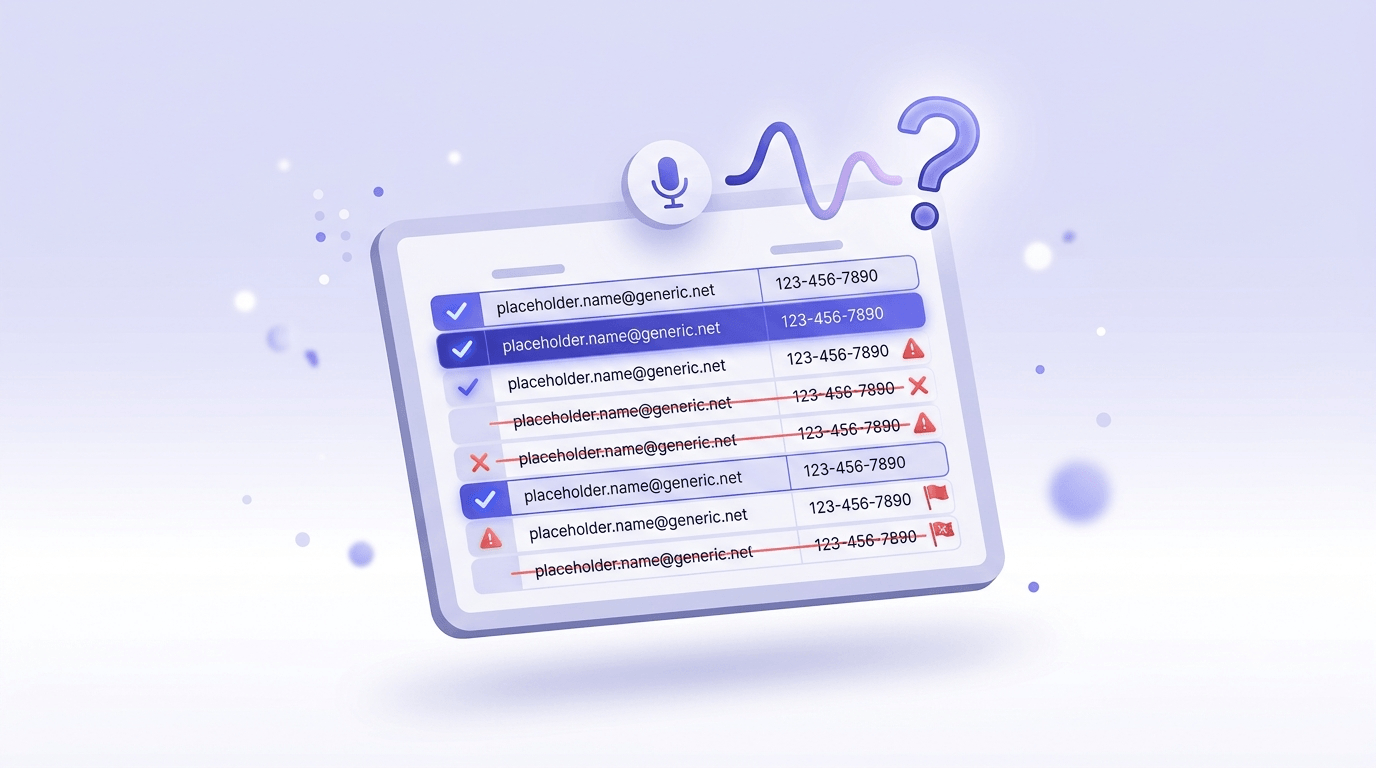
AI cold calling is one of the most searched phrases in B2B sales right now — and one of the most poorly defined. Half the content out there is vendor marketing for autonomous voice robots. The other half is Salesforce-style guidance about AI-powered rep tools. They're describing completely different things, and confusing them will either land you in a legal mess or leave you with a glorified dialer that hammers a rotten contact list at scale.
By the end of this guide you'll know exactly which model fits your team, what the FCC ruling actually requires, and why every AI cold calling workflow has the same single failure point — the list it runs on.
The piece you won't find anywhere else: how to use email verification as a fast, cheap proxy for phone list quality before you burn through a single minute of AI call time.
What AI cold calling actually means (and what it doesn't)
There are two distinct models in the wild, and vendors use "AI cold calling" to describe both without distinguishing them.
The rep-augmentation model is what Salesforce and most CRM-adjacent vendors mean. A human rep makes the call. AI tools transcribe the conversation in real time, surface next-best-response prompts, score the lead, and push a structured summary to the CRM the moment the call ends. The rep is still talking. The AI is running support in the background.
The autonomous voice agent model is what Retell, Synthflow, and Bland sell. An LLM-powered voice agent holds the conversation end-to-end — no human on the line. It introduces itself, handles objections, books meetings, and escalates to a human only when it hits a predefined trigger. No rep required for the first touch.
This distinction matters for two reasons. First, legal exposure: autonomous voice agents fall squarely under the FCC's February 2024 TCPA ruling; rep-augmentation tools generally don't. Second, conversion rate: prospects who realize they're talking to a robot — and many do — hang up faster than they'd hang up on a bad human rep.
The robodialers of 2015–2020 were a cruder version of the autonomous model. They played pre-recorded audio, offered no real conversation, and got hammered by regulators and spam filters alike. Today's voice agents are genuinely different — they can handle unexpected replies, recover from tangents, and maintain a conversational cadence that's hard to distinguish from human speech at first listen. That capability is exactly what made the FCC move.
The legal landscape in 2026: what the FCC ruling actually says
On February 8, 2024, the FCC issued a Declaratory Ruling clarifying that AI-generated voices qualify as "artificial or prerecorded" under the Telephone Consumer Protection Act (TCPA). That's not a new law — it's a clarification that the existing TCPA framework applies to AI voice agents the same way it applied to robocalls.
What that means practically:
- Prior written consent is required before using an AI voice agent to call a mobile number for marketing purposes. Verbal consent during a previous call doesn't satisfy this.
- Opt-out must be honored immediately. If a prospect says "remove me from your list," the agent must stop and the number must be suppressed before the next dial.
- B2B calls to landlines have more room — TCPA primarily targets mobile numbers and residential lines — but state laws frequently close that gap.
- Disclosure is required in several states: the agent must identify itself as AI within the first few seconds of the call.
California (CCPA + AB 302), Florida (Florida Telemarketing Act), and Texas (TDTSA) all sit stricter than the federal floor. If your list includes numbers in those states, you need state-specific legal review before running autonomous agents.
Here's the gap most vendors gloss over: their marketing talks about "compliant AI calling" without specifying what compliance actually requires from you. The vendor's platform may be technically capable of honoring opt-outs. Whether your list was built with proper prior consent is entirely your problem.
Safe harbor pattern
Teams with serious compliance risk are using AI for pre-call prep (research, scoring, script generation) and post-call logging — both of which are clearly outside TCPA scope — while keeping humans on the actual call. Rep-augmentation sidesteps the ruling entirely.
How AI-assisted cold calling works (the rep-augmentation model)
If your deal size is above $10K or your buyers are senior decision-makers, this is the model worth understanding in depth.
Real-time transcription is the foundation. Tools like Gong, Chorus, and Dialpad transcribe the call as it happens, analyze sentiment, and surface prompts — "ask about their current vendor" or "they mentioned a Q3 budget cycle" — in a sidebar the rep can glance at without losing the thread of the conversation.
After the call, the AI writes the CRM entry: call summary, sentiment score, next action items, and any commitments made — all pushed to HubSpot or Salesforce without the rep lifting a finger. That alone saves 15–20 minutes per call for a productive rep doing 40 calls a week.
Before the dial, AI lead scoring prioritizes which accounts to call first. Intent data signals — a target account visiting your pricing page three times, or a job posting that signals budget for your category — get weighted into a score that tells the rep who's actually warm right now versus who's just in the CRM.
Post-call coaching is where the training loop closes. The AI flags moments where the rep talked too much, where an objection went unanswered, or where the conversation stalled. Over time, this is the feature that actually improves rep performance — not just efficiency.
How autonomous AI voice agents work (the full-automation model)
An autonomous voice agent is, at its core, an LLM connected to a text-to-speech engine and a telephony stack. The LLM processes what the prospect says, generates a response, and the TTS engine speaks it — all in a loop that has to complete in under 300 milliseconds to feel like a natural conversation.
That 300ms threshold is why latency is the primary engineering challenge. Above it, the pause is perceptible. Prospects register it as "something is off" before they consciously identify what. The best vendors have solved this with streaming inference and edge-deployed TTS — but it's still the spec to ask about when evaluating platforms.
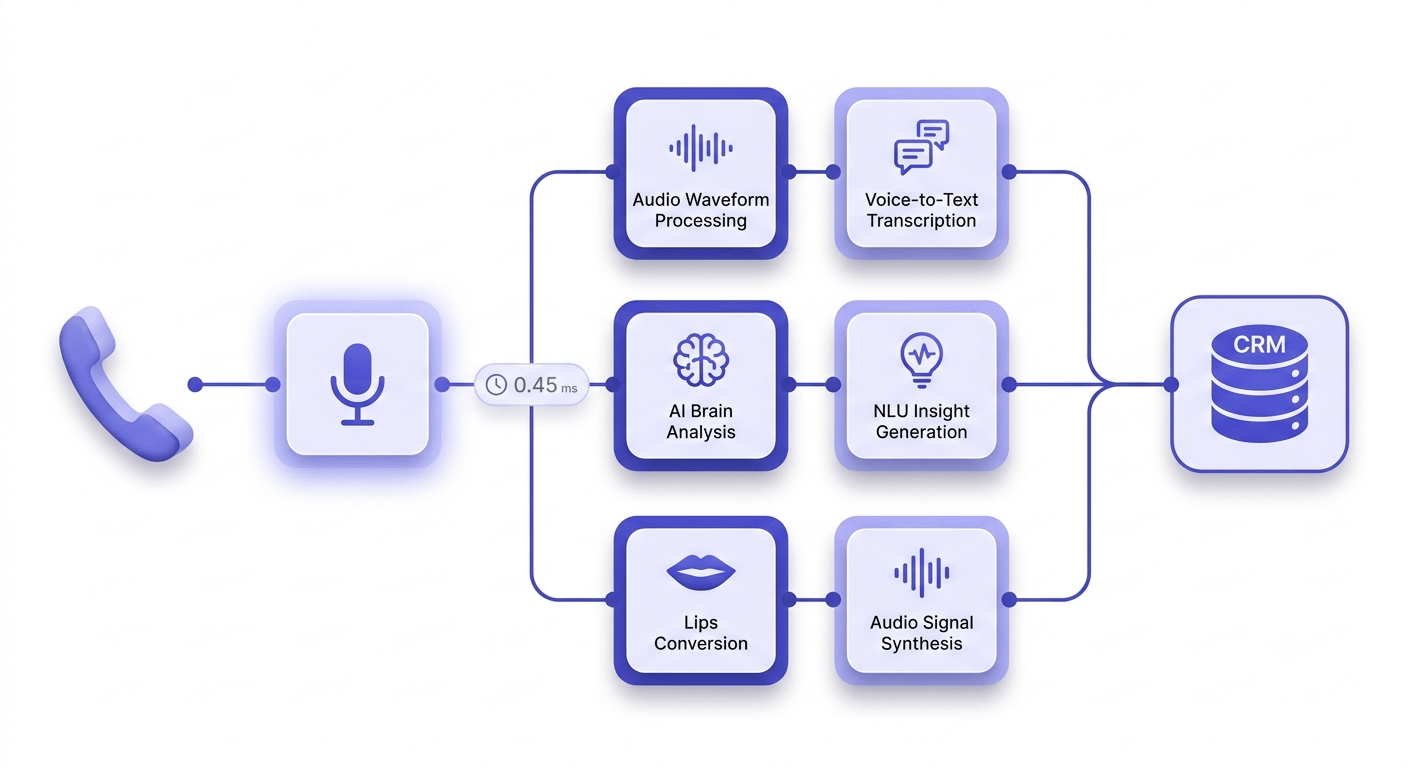
CRM and calendar integrations are what make the autonomous model economically compelling. When an agent books a meeting, it lands directly in the rep's HubSpot or SendGrid workflow — no human touch between the conversation and the booked slot. For high-volume, low-ACV outreach, that's a real cost reduction.
Objection handling libraries are trained on real call recordings — usually thousands of hours from the vendor's customer base. The better vendors let you upload your own call library and fine-tune against your specific product objections. The weaker ones give you a generic script and call it "AI."
Warm handoff mechanics matter more than most buyers realize. A good agent detects signals that a human should take over — a prospect expressing serious intent, a complex technical question, or explicit frustration — and transfers the call live. A bad agent either never hands off (prospect hangs up) or hands off too early (defeats the purpose).
Where AI cold calling breaks down
Reddit's r/sales has been a reliable signal here. The consensus among experienced reps: prospects who interact with AI agents regularly can identify them within 30 seconds, and the reaction is rarely neutral. Being transferred to an AI for a first touch reads as "this company doesn't value my time enough to have a human call me" — which is a hard frame to recover from in a long sales cycle.
Complex enterprise deals break the model structurally. A 6-month deal involving five stakeholders, a security review, and a custom contract requires relationship context that can't be captured in a prompt. The AI has no memory of the champion's internal politics, the economic buyer's stated concerns from a conference six months ago, or the fact that procurement blocked the last vendor for a specific reason.
High-ACV deals amplify every mistake. A bad first impression from an AI agent on a $200K opportunity doesn't cost you a $50 MRR churn — it costs you the deal, the referral network, and potentially the category relationship. The math on autonomous agents stops working above a certain deal size.
And then there's the data problem — which is where most AI cold calling deployments actually fail, and where almost no vendor content goes.
AI dialers don't fix a dirty list. They just call it faster. A list with 25% invalid phone numbers means the AI is burning call minutes on dead numbers at the same rate a human would — except at 10x the volume. The velocity that makes autonomous agents attractive is the same velocity that makes bad data catastrophic.
Using AI to practice cold calling (the training use case)
This is the one AI cold calling application that sidesteps TCPA entirely, and it's underused.
AI role-play bots simulate prospect personas — the skeptical CFO, the gatekeeper who's heard every pitch, the champion who needs to sell internally. They generate realistic objections, interrupt at awkward moments, and push back on weak value props. The rep practices the conversation without touching a real prospect.
Post-session scoring is what separates this from just reading a script out loud. The AI grades talk ratio (reps who talk more than 55% of the time in discovery calls consistently underperform), filler word frequency, objection response quality, and whether the rep actually asked for the next step. Instant, specific, repeatable feedback.
Platforms like HigherLevels are built specifically for this training loop. The value proposition for sales managers is clear: a new SDR who does 30 AI practice sessions before their first real dial ramps in weeks, not months. The failure mode of a live call — losing a real prospect while learning — doesn't exist in the training environment.
No real numbers are dialed. No consent is required. No TCPA exposure. For teams that are nervous about the legal complexity of autonomous agents, this is the highest-ROI AI cold calling investment available right now.
The email verification angle: why AI dialers fail on dirty data
Most AI cold calling workflows start with a prospect list pulled from Apollo, ZoomInfo, or a LinkedIn scrape. That list contains both email addresses and phone numbers for the same contacts. The two data points age together.
When someone leaves a company, their email bounces and their direct-dial number gets reassigned. When a company shuts down, the entire domain goes cold. When someone never existed and was fabricated by a data vendor's enrichment algorithm, both the email and phone number are garbage. These aren't independent signals — they're correlated indicators of the same underlying list quality problem.
Here's the practical implication: a list with 20% invalid emails almost certainly has proportional phone number decay. Verifying the email layer before you upload to a dialer is the cheapest, fastest proxy for overall list health you have.
Valid Email Checker's 11-stage verification engine runs every address through syntax check, MX record validation, SMTP handshake, mailbox-existence probe, catch-all detection, role address detection, disposable domain detection, spamtrap detection, mailbox-full detection, and disabled-account detection. The result is a classification into one of 10 possible statuses — not a binary pass/fail.
That breakdown tells you things a simple bounce check misses. A high catch-all rate means the domain accepts everything — you can't verify mailbox existence, and phone numbers at those companies are equally unverifiable. A cluster of disposable emails signals the list was built from form submissions by people who didn't want to be contacted. Role addresses (info@, sales@, hello@) are shared inboxes — the "contact" in your dialer is a team queue, not a person.
All three of those patterns correlate with phone number quality problems. None of them show up in a raw dial attempt.
If you want to go deeper on what each verification status means and how to act on it, the Email Verification: The 11 Stages & Every Status Explained guide walks through the full engine. For the cold outreach context specifically, Cold Email Outreach: The List Quality Lever covers how list health translates directly into campaign ROI.
Free tool · no signup
Check your contact list before uploading to a dialer
Paste in a sample from your prospect list and see the verification breakdown — invalid, disposable, catch-all, and role addresses flagged instantly.
For larger lists, bulk email verification lets you upload the full CSV and get a structured results file back — filtered by status, ready to segment before you touch a dialer or an ESP.
Choosing the right AI cold calling approach for your team
The decision comes down to three variables: deal size, compliance risk tolerance, and weekly dial volume.
| Factor | Autonomous voice agents | Rep-augmentation AI |
|---|---|---|
| Best deal size | Under $5K ACV | $10K+ ACV |
| Weekly dial volume | 500+ dials/week to justify cost | Works at any volume |
| TCPA exposure | High — requires prior written consent | Low — humans make the call |
| Prospect experience | Mixed; detectable as AI by ~30s | Identical to a normal call |
| CRM integration | Automated booking, no human touch | AI-assisted logging post-call |
| Cost model | $0.05–$0.20/min of call time | $50–$150/seat/month |
| Best for | High-volume SMB, re-engagement, scheduling | Mid-market, enterprise, complex sales |
SMB and high-volume outreach teams making 500+ dials a week can make the autonomous agent model work economically — especially for re-engagement campaigns where the prospect already knows the brand and consent documentation is cleaner. Below that volume, the operational overhead of managing an AI agent stack (training, compliance review, objection library maintenance) eats the savings.
Mid-market and enterprise teams should default to rep-augmentation. The conversion rate differential at higher deal sizes more than pays for the extra human time. And the compliance risk of autonomous agents at enterprise scale — where a single misstep can trigger a class-action referral — isn't worth the cost savings.
The one thing every model shares: list quality sets the ceiling. A rep-augmentation tool running on a stale list wastes rep time. An autonomous agent running on a stale list wastes rep time and burns call budget simultaneously. The email deliverability checker gives you a read on your domain health before any campaign goes out — relevant whether you're sending email or calling from the same domain infrastructure.
Audit your list before any dialer campaign
Pull a 500-row sample from your prospect list and verify the email layer. A result showing more than 15% invalid or disposable addresses is a signal to pause and source a cleaner list — not to start dialing.
Choose your model based on deal size and compliance exposure
Under $5K ACV and 500+ dials/week? Autonomous agents can work. Above $10K ACV or operating in California, Florida, or Texas without airtight consent documentation? Rep-augmentation is the safer, higher-converting path.
Train before you dial
Whether you're running reps or agents, use AI role-play tools to stress-test your script against the objections your list will actually throw. This step has zero TCPA exposure and pays back in lower call abandonment rates.
Set up warm handoff thresholds before launch
For autonomous agent deployments, define the escalation triggers before the first campaign goes live — not after the first complaint. Prospects expressing serious interest, asking for pricing, or flagging frustration should route to a human within seconds, not minutes.
Monitor bounce and opt-out rates as leading indicators
High opt-out rates from an AI agent campaign are the same signal as high email unsubscribes — your list targeting is off or your list is stale. Both problems trace back to data quality, and both are cheaper to fix before the campaign than after. See how to reduce email bounce rate below 2% for the parallel email-side framework.
For a broader view of how list quality affects every outreach channel — email and phone alike — the Email Deliverability: Why List Quality Matters More Than Authentication pillar guide is the most complete treatment we've published.
Frequently asked questions
Is AI cold calling legal in 2026?
What's the difference between an AI cold calling tool and an AI voice agent?
Can prospects tell when they're talking to an AI?
How do AI cold calling tools integrate with CRMs like HubSpot and Salesforce?
What happens to my sender reputation if my AI dialer is working off a dirty contact list?
Which companies are the main AI cold calling platforms right now?
Can I use AI to practice cold calling without legal risk?
How much does AI cold calling software cost?
AI cold calling tools can compress outreach volume, improve rep efficiency, and cut CRM admin time — but none of that matters if the list underneath is stale. The fastest way to find out whether your prospect data is worth dialing is to verify the email layer of your outreach list before a single minute of call time gets spent. The result breakdown will tell you more about your list health than any dialer report will.
Try Valid Email Checker free
Verify any email in under a second
Get 150 free verifications. No credit card. Auto-refund on every Unknown result — the only verifier we know that does this.
- 150 free credits when you sign up
- Auto-refund every Unknown verification (we're the only ones that do)
- 11-stage flow catches what 1-step checkers miss
- Drop-in integrations for Mailchimp, HubSpot, SendGrid, 14 more
Written by
Emmanuel KwartengEmmanuel is the founder of Valid Email Checker. He spends most of his time in bounce logs, verification data, and the gap between what email vendors promise and what actually happens when you hit send. He started the company because too much deliverability advice is guesswork dressed up as best practice, and he writes here to cut through it with the numbers behind each claim.