Cold Email Follow-Up: Why List Quality Matters More Than Copy
 Priya IyerJuly 6, 2026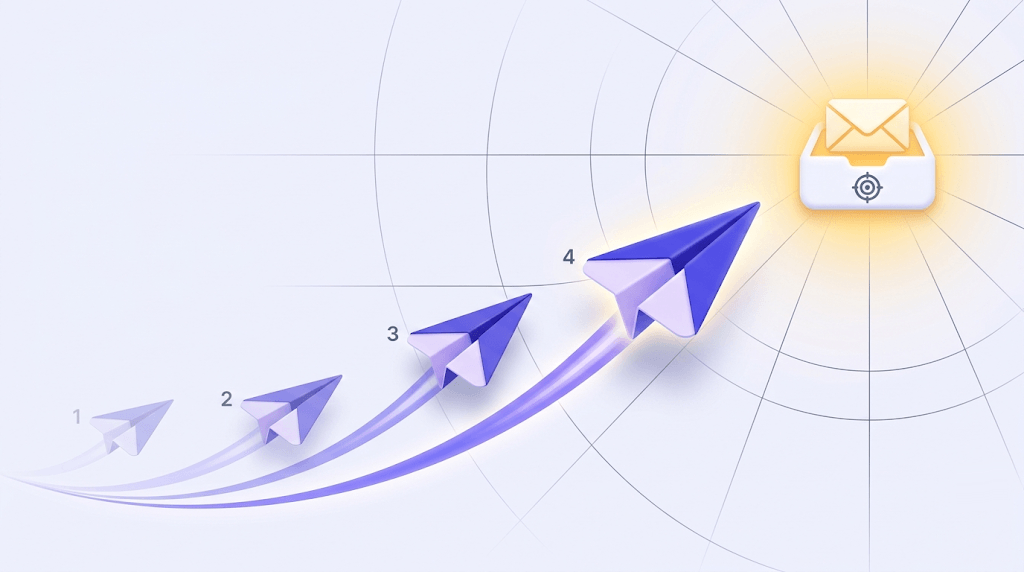
55% of replies to cold email campaigns come from follow-up messages, not the opener. Most senders never find out — because they stop after one send.
If you've been treating the first email as the main event, this post will change how you think about sequences. You'll have a defensible cadence, know exactly what to write at each step, and understand why list quality — not just copy — determines whether your follow-ups land in inboxes or disappear into spam folders.
The specific angle most guides miss: every invalid address in your list receives multiple sends across a sequence, not just one. The bounce damage compounds. We'll cover that too.
Why most cold email sequences die after the first send
70% of sales emails stop after the first attempt. One email, no response, the contact goes cold in the CRM forever. This isn't a content problem — it's a persistence problem.
Executives receive an average of 120 emails per day. Your first message didn't get rejected. It got buried. The prospect may have scanned the subject line at 7pm on a Thursday, intended to come back to it, and never did. A follow-up isn't nagging — it's a second door knock at a more convenient time.
The data backs this up. Woodpecker's send-volume research found that adding a single follow-up increases reply rate by 22%. That's not a marginal gain from a small tweak — it's a structural lift from doing the obvious thing most senders skip.
The mindset shift that matters: the first email is an introduction. The follow-up sequence is the actual conversation. If you write your opener expecting it to close the loop on its own, you'll write the wrong email and skip the follow-ups that would have done the work.
How many follow-ups to send (and when to stop)
Three follow-ups after the opener is the practical sweet spot for most B2B cold outreach. That gives you four total touchpoints — enough to catch a prospect at a better moment without crossing into noise.
The floor is two follow-ups. One follow-up is better than none, but you're leaving the third-touch reply rate on the table. Research consistently shows that 80% of sales require at least five touchpoints, but that number includes warm leads, referrals, and existing relationships. For a cold list — people who've never heard of you — three to four touches is more honest.
The ceiling depends on deal size and list warmth. A $150K enterprise deal can justify six or seven touches with meaningful gaps between them. A $49/month SaaS subscription probably can't — the cost of irritating the list exceeds the value of an extra reply or two.
Cold list vs. warm list
If your list came from a tool like Apollo or LinkedIn scraping, treat every contact as cold — three to four touches, then move on. If the list includes conference attendees, people who downloaded a resource, or past customers from a churned cohort, they've shown prior intent. You can go deeper: five to six touches with more direct asks.
No response after three attempts is a signal, not a failure. Move the contact to a long-term nurture sequence or a re-engagement campaign six months out. Don't burn the relationship by pushing past the point where persistence tips into harassment.
The case against ten-touch sequences: they work for a narrow slice of high-ACV outbound sales where the prospect is a named target and the deal justifies the time. For everyone else, ten emails to the same cold contact guarantees spam complaints, unsubscribes, and a sender reputation that starts pulling down your deliverability across the entire domain.
Timing and cadence: the intervals that actually work
A 3-day interval between follow-ups consistently outperforms in high-volume send data. The 2–5 day range is defensible; shorter than 2 days feels aggressive, longer than 5 days loses the thread.
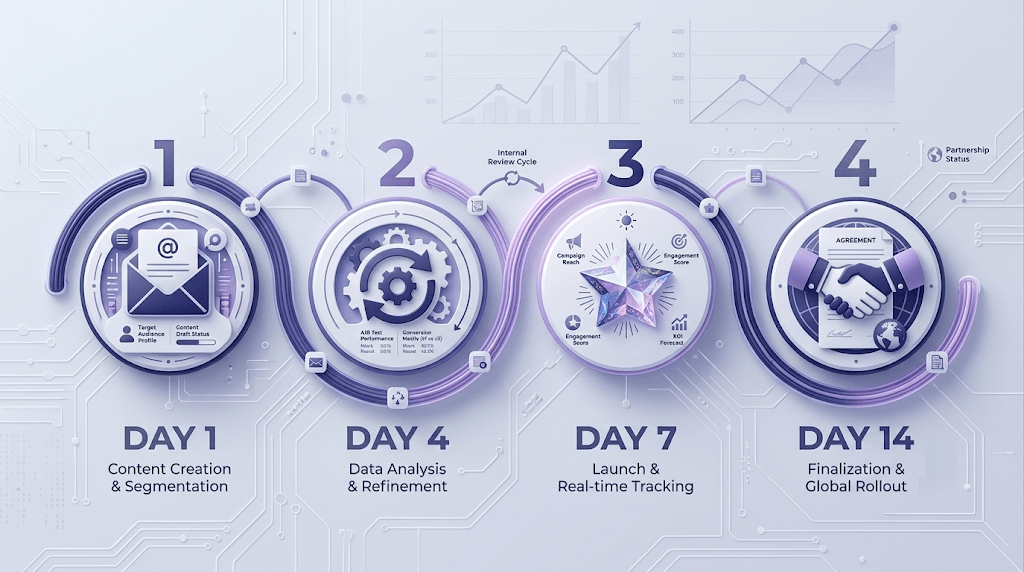
Here's the default cadence that works for most B2B cold outreach:
- Day 1 — Opener
- Day 4 — Follow-up 1 (reframe the value prop)
- Day 7 — Follow-up 2 (social proof or alternative angle)
- Day 14 — Follow-up 3 (the break-up email)
The logic behind the taper: intent is freshest in the first week. The Day 4 and Day 7 emails arrive while the prospect may still have context from the opener. The Day 14 gap creates distance — it signals that you're not hammering daily, and the break-up framing at that stage lands more naturally after a pause.
Time-of-day and day-of-week still matter. Tuesday through Thursday mornings continue to outperform Friday afternoons and Monday mornings across most B2B sends. Monday is inbox-clearing day; Friday is mentally checked-out. Wednesday at 8–10am local time is the single most reliable slot if your tooling supports timezone-aware delivery.
The more important upgrade is trigger-based sends. If a prospect clicks a link in your opener but doesn't reply, that's a buying signal. A fixed cadence ignores it. Trigger-based logic — send follow-up 1 immediately when a click is detected, rather than waiting for Day 4 — catches the moment of highest intent. Most modern sequence tools support this; use it.
What to write in each follow-up
The most common follow-up mistake is copying the opener and changing the subject line. Every email in the sequence should earn its place with a different angle, a new piece of evidence, or a different ask.
Follow-up 1: the reframe
A different angle on the same value prop. If the opener led with time savings, follow-up 1 might lead with cost reduction or a risk you help them avoid. Keep it short — three sentences is ideal. You're not re-pitching; you're offering a second reason to care.
Follow-up 2: social proof or an alternative offer
One concrete result from a company similar to theirs. Not 'our customers love us' — a specific outcome: '{{Company}} reduced their bounce rate from 8% to 0.4% in one campaign.' If you don't have a relevant case study, pivot to an alternative offer: a free audit, a resource, a shorter call format.
Follow-up 3: the break-up email
Short, direct, and generous. Give the prospect an easy out. 'If this isn't a priority right now, just say the word and I'll stop reaching out — no hard feelings.' This email consistently gets replies because it removes the pressure. The response is often 'not now but try me in Q3' — which is exactly the signal you need.
Two rules that apply across every follow-up: each one should be shorter than the one before it, and none of them should open with 'Just bumping this to the top of your inbox.' That phrase is the written equivalent of a shrug — it adds nothing and signals you have nothing new to say.
Every follow-up should add one of three things: credibility (proof it works), urgency (a real deadline or limited availability), or a new angle (something they haven't heard yet). If you can't identify which one a given email adds, rewrite it before it sends.
Subject lines that get follow-ups opened
Here's the practical answer on subject lines: keep the same thread for follow-ups 1 and 2. Replying within the existing thread maintains context, feels human, and shows inbox providers a conversation is happening rather than a broadcast. Most recipients will see 'Re: [original subject]' and remember the opener.
The exception is follow-up 3, or any email sent to a list where the opener had near-zero opens. If nobody opened the first message, the thread context is worthless — there's no context to reference. A fresh subject line is a legitimate reset. Treat it as a second opener: short, specific, personalized.
Subject line patterns that consistently outperform:
- Question-based — 'Still worth a conversation?' performs better than most openers
- One word — 'Thoughts?' or 'Available?' with a strong first line to follow
- Forward-style — 'Re: [original subject]' for continuity within the thread
- First name + specific detail — 'Sarah — saw {{Company}} just hired three AEs' lifts open rates meaningfully
Patterns that damage deliverability regardless of open rate: spam-trigger words (free, guarantee, urgent, act now), ALL CAPS anywhere in the subject, and three or more punctuation marks in sequence. These don't just look like spam — they get filtered as spam by Gmail and Outlook's rule sets. See the Google email sender guidelines for the current list of signals that trigger filtering.
Deliverability: the follow-up problem nobody talks about
Most cold email guides treat copy and deliverability as separate problems. They're not — and the interaction between them gets worse with every follow-up you add to the sequence.
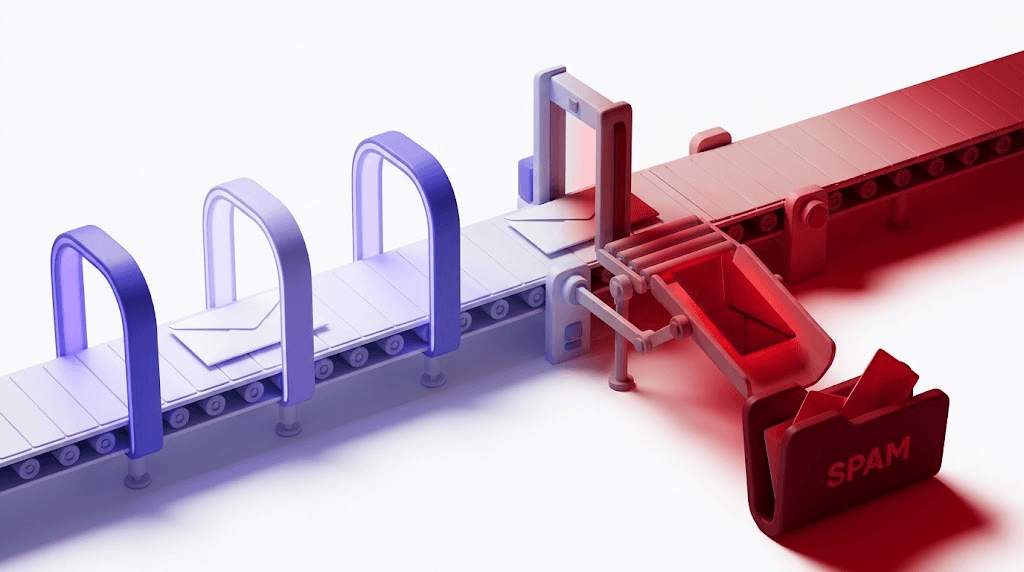
Here's the compounding math: if 5% of your list is invalid and you send a four-email sequence, every invalid address generates four bounce events instead of one. A list of 1,000 contacts with 50 invalid addresses produces 200 bounces across the sequence. A single campaign that would have posted a 5% bounce rate now posts one that inbox providers track across four separate send events — each one a fresh signal that your list is unverified.
A bounce rate above 2% signals to inbox providers that your list hasn't been maintained. Gmail and Yahoo made this explicit in their 2024 bulk sender requirements. Once your domain or IP crosses that threshold, inbox placement drops for the entire sending pool — not just the bouncing addresses. Your clean contacts start landing in spam because of the bad ones.
Two specific failure modes cold senders encounter but rarely diagnose correctly:
Catch-all domains. These are domains configured to accept all incoming mail regardless of whether the specific mailbox exists. Your opener delivers successfully — no bounce. But the follow-up, sent days later, may hit a different server state or trigger a deferred rejection. The address looked valid; it wasn't. Our catch-all emails guide explains how to identify and handle these in a cold list.
Role addresses. Addresses like info@, sales@, and hello@ are shared inboxes. They rarely engage with cold outreach, drag your overall engagement rate down, and in some cases are monitored as spam traps by abuse teams. Including them in a cold sequence is a sender reputation liability with almost no upside.
The fix is structural: verify your cold list before the first send, not after the first bounce report. Verification protects the entire sequence — not just email 1. Every subsequent send to a clean list is a clean send. Every subsequent send to an unverified list multiplies the damage.
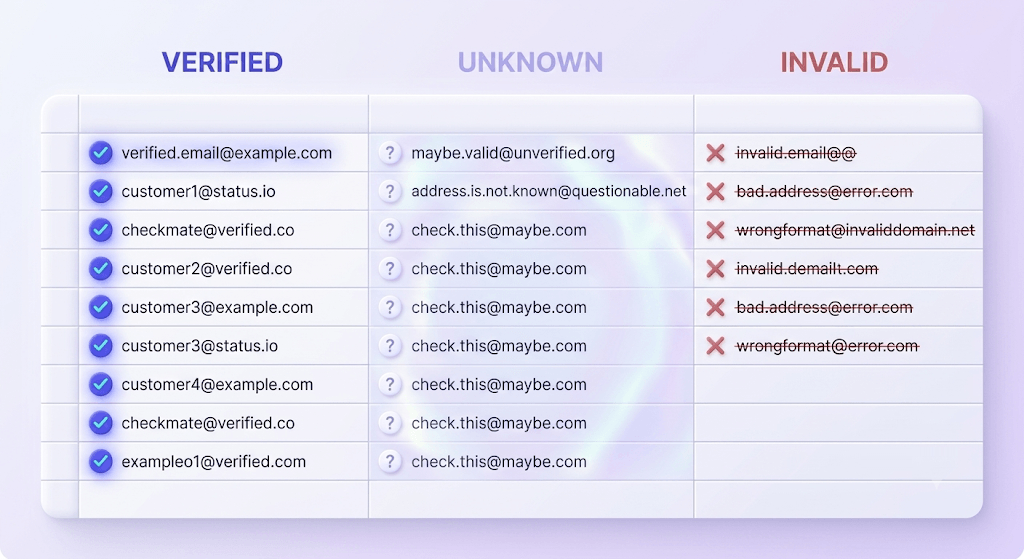
Unknown-status results are the ambiguous middle ground. These are addresses where the verification engine can't get a definitive answer — the server responded in a way that doesn't confirm or deny mailbox existence. Most verifiers charge for these and leave you to guess. Valid Email Checker automatically refunds credits for every Unknown result, because charging you to be uncertain isn't something we're willing to do. See the full explanation of every result type if you want to understand what each status means for your list strategy.
Free tool · no signup
Verify your cold list before the sequence goes out
11-stage verification catches invalid, catch-all, role, and disposable addresses. Unknown results are auto-refunded.
If you're already mid-sequence and suspect your sender reputation has taken a hit, check whether your sending IP is blacklisted before the next send. A blacklisted IP means your follow-ups aren't being filtered into spam — they're being rejected before they reach the inbox at all.
5 cold email follow-up templates you can use today
These are starting points, not copy-paste scripts. The personalization variables are in double curly braces — fill them with real data or the templates are worthless.
Template 1: the value-add follow-up
Subject: Re: [original subject]

Hi {{First name}},

Wanted to share something that might be relevant — we put together a short guide on [specific topic relevant to their role].

[Link or one-sentence description of the resource]

Thought it might be useful regardless of whether we end up working together.

Worth a quick look?

[Your name]
Template 2: the pain-point pivot
Subject: Re: [original subject]

Hi {{First name}},

I may have led with the wrong angle last time.

A lot of {{role/title}} we talk to are less focused on [original angle] and more concerned about [alternative pain point].

If that's closer to what's on your plate, it might be worth a 15-minute call.

[Your name]
Template 3: the social-proof bump
Subject: Re: [original subject]

Hi {{First name}},

Quick one: {{Similar company}} was dealing with [specific problem] and got [specific result] within [timeframe].

Think there's a similar opportunity at {{Prospect company}}. Happy to share the details if useful.

[Your name]
Template 4: the short ask
Subject: Re: [original subject]

Hi {{First name}},

Is [the problem you solve] still a priority this quarter?

Even a yes or no helps me understand where to focus.

[Your name]
Template 5: the break-up email
Subject: Closing the loop

Hi {{First name}},

I've reached out a few times and haven't heard back — completely understand if the timing is off or this isn't relevant.

I'll stop following up after this. If things change and [the problem] becomes a priority, feel free to reach out directly.

Either way, best of luck with [specific thing you know about their business].

[Your name]
The break-up email works because it removes pressure and signals respect for the prospect's time. The reply rate on final-touch emails is consistently higher than follow-up 2 — not because the prospect suddenly became interested, but because the low-stakes framing makes it easy to respond. 'Not now but circle back in Q2' is a reply that saves the relationship.
Building a follow-up system that runs without manual tracking
Manual calendar reminders for follow-ups always slip. The reminder fires at the wrong time, you're in a meeting, you snooze it, and three days later you've lost the window. The only reliable follow-up system is one that runs on non-reply logic — if the contact hasn't responded, the next email in the sequence sends automatically.
Minimum viable automation for a cold sequence:
- A three-step drip (opener + two follow-ups) with non-reply triggers between each step
- Auto-pause on reply — the sequence stops the moment a response comes in, regardless of where the contact is in the cadence
- Auto-pause on bounce or unsubscribe — non-negotiable; continuing to send after a hard bounce is how domains get blacklisted
- A fourth optional step (the break-up email) at Day 14, sent from a separate trigger
Track reply rate per step, not just aggregate open rate. Open rate tells you the subject lines are working. Reply rate per step tells you which email in the sequence is carrying the conversion weight — and which one you should rewrite or cut. Most senders find that follow-up 1 and the break-up email generate the bulk of replies; follow-up 2 is often the weakest link and worth testing aggressively.
List hygiene is infrastructure, not a one-time task. The right time to verify a cold list is before you load it into the sequence tool — not after the first bounce report comes back. Once you've taken the sender reputation hit, the remediation is slower and more painful than the verification would have been. The email list hygiene decision framework covers when to re-verify a list that's been sitting idle and how often to clean lists you send to regularly.
For a deeper look at how bounce rate and list quality interact with inbox placement across an entire sending program — not just a single cold sequence — the email deliverability guide is the most complete resource we've published.
Check an address before it goes into your sequence
Paste any email and see the full 11-stage verification result. Unknown results are auto-refunded.
Powered by Valid Email Checker — full SMTP handshake, disposable + role detection, no card required.
Free tool · no signup
Test your sender reputation before the sequence goes out
Check inbox placement, authentication, and domain health in one pass.
A clean list going into a well-timed sequence is the combination that actually moves reply rates. The templates and cadence above will get you most of the way there — the verification step is what keeps the deliverability from unraveling as the sequence runs.
Frequently asked questions
How many follow-up emails should I send after a cold email?
How long should I wait between cold email follow-ups?
What should I write in a cold email follow-up if there's been no response?
Should I use the same subject line for follow-up emails?
When should I stop following up on a cold email?
Why are my cold email follow-ups going to spam?
How does a high bounce rate affect my cold email follow-up sequence?
What is a break-up email and does it actually work?
Try Valid Email Checker free
Verify any email in under a second
Get 150 free verifications. No credit card. Auto-refund on every Unknown result — the only verifier we know that does this.
- 150 free credits when you sign up
- Auto-refund every Unknown verification (we're the only ones that do)
- 11-stage flow catches what 1-step checkers miss
- Drop-in integrations for Mailchimp, HubSpot, SendGrid, 14 more
Written by
Priya IyerPriya writes about the human side of email — how you word it, when you send it, and how to grow a list without wrecking your deliverability. From sign-offs and subject lines to lifecycle automation and list hygiene, she's after email that respects the reader's inbox and still gets results. Her north star: more opens and replies, fewer unsubscribes and spam complaints.